


17 October 2025
A Deeper Understanding: Reflections on the Autism Ally Event by Sophie Jepson, Business Growth Officer at Skills and Education Group.
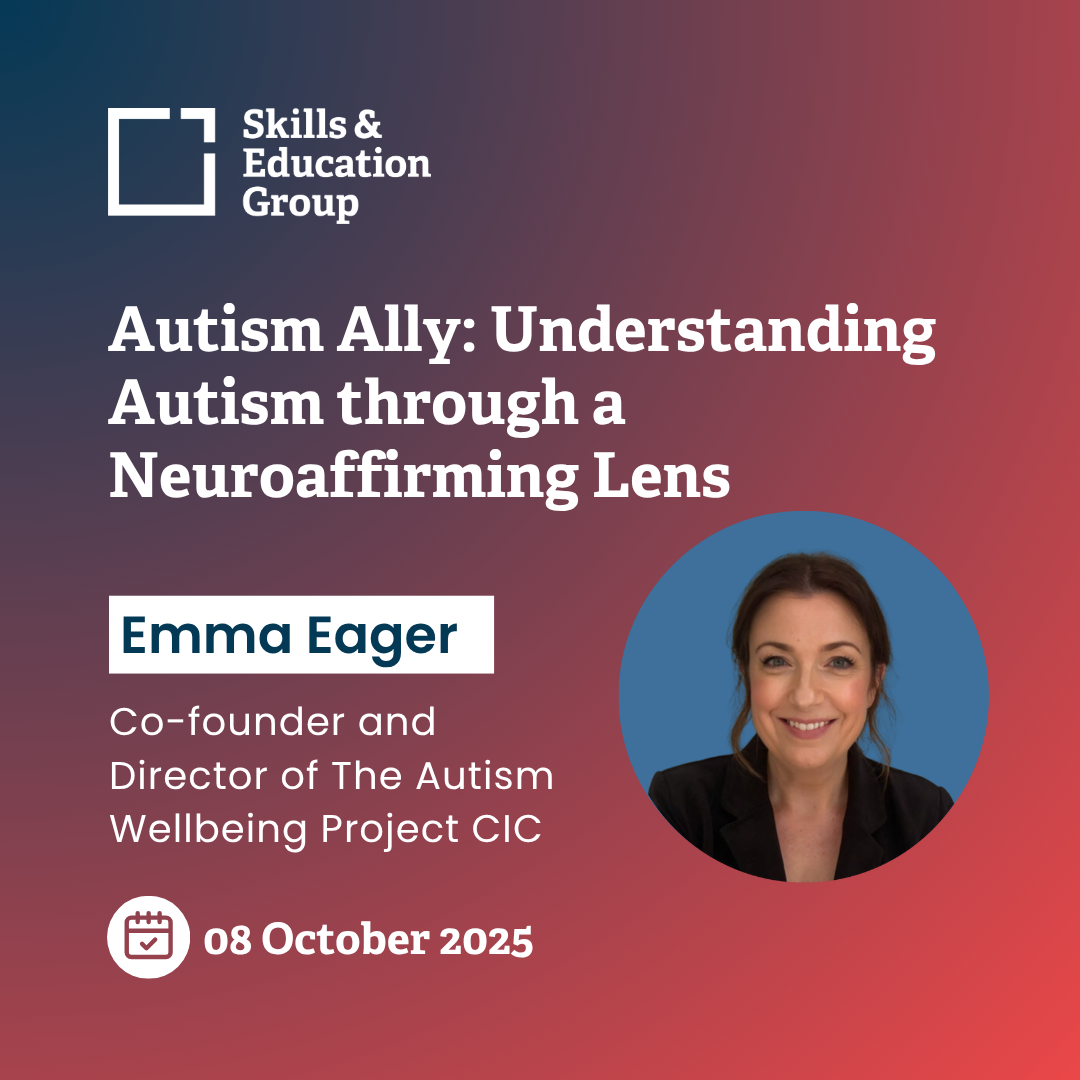
I recently had the privilege of attending an Autism Ally CPD event hosted by Skills and Education Group. The event led by Emma Eager, Director at the Autism Wellbeing Project, featuring John Birkill, an expert by experience, completely shifted my perspective. What started as a foundational understanding quickly became a powerful lesson in empathy, language, and respect.
The core message, delivered with such clarity by Emma, was about changing the landscape for autistic people, moving from a place of simply enduring to one of genuine inclusion and support.
The Problem with Medicalised Language
The part that resonated most with me was the discussion on language. Before this event, I honestly hadn’t stopped to consider the profound impact of the words we use. Emma highlighted that a formal autism diagnosis often comes with the medical label of autism spectrum disorder (ASD), characterised by terms like “impairments”, “deficits”, or “abnormalities”.
This deficit-based, medicalised language frames autism as a disorder to be treated, portraying autistic individuals as deficient or broken. This damaging view overlooks an individual’s strengths. Emma’s nonprofit, The Autism Wellbeing Project, believes autistic individuals are “able, neurodiverse humans who deserve curiosity, acceptance, understanding and support.” The simple shift from talking about deficits to recognising differences is a massive and necessary step toward true allyship.
The Lived Experience: A Brave and Crucial Insight
John Birkill’s contribution as an expert by experience was deeply moving and incredibly important. His story underscored the severity of the challenge many autistic individuals face in a world that doesn’t understand them.
He shared that for his whole adult life he was treated for anxiety and depression, only being diagnosed formally with autism a year ago. It was a stark reminder of the misdiagnosis and struggle that so many go through. He bravely spoke about the high rate of suicide among autistic men, noting the difficulty in accessing mental health services. His insight was a wake-up call for practitioners:
"I can sit there and look completely calm and speak completely normally when I am running around inside my head in circles screaming."
This ability to mask or present as “normal” means that a professional might think a person is only struggling a little bit when they are actually at a crisis point. It highlights a desperate need for greater professional awareness of how autism can present internally.
Focusing on Strengths, Not Just Struggles
The session ended on a powerful note of hope and optimism: a focus on strengths. Hearing about Emma’s award-winning company, which employs a significant number of autistic people, from co-trainers to a marketing apprentice, was inspiring.
It was inspiring to discover the counter-narrative to the deficit model through the list of strengths that Emma and John provided. These include:
- Attention to Detail: Spotting patterns and errors others miss.
- Focus and Persistence: Incredible concentration and dedication when interested.
- Honesty and Integrity: Reliability and transparency, leading to deep trust.
- Creative and Analytical Thinking: Excelling in problem-solving and “out of the box” ideas.
- Technical Skills: Natural aptitude in areas like IT, engineering, and data analysis.
John’s reflection that he doesn’t necessarily see autism as a disability, though he acknowledges it can be disabling, struck a chord. And as Emma pointed out, it is often society that disables autistic people, not their intrinsic ability.
The heartbreaking statistic that only about 20% of autistic people are in employment reflects not their talent, but inaccessible recruitment processes and inflexible workplace cultures. If we, as allies and employers, work to recognise these immense and loyal talents, we can build truly inclusive workplaces and give autistic people the opportunities they deserve.
My biggest takeaway from this event? Allyship begins with language, progresses to understanding, and ultimately results in action, creating spaces and systems that support and celebrate neurodiversity.
I’m leaving this event committed to using affirming language and advocating for true accessibility, not just in the workplace but in everyday life.
Take a look at our other CPD Events here.